
- 60–90 minin-office session
- 1–2 sessionstypical course
- 1–3 yearsresult with maintenance
- Same dayvisible change
How teeth whitening works
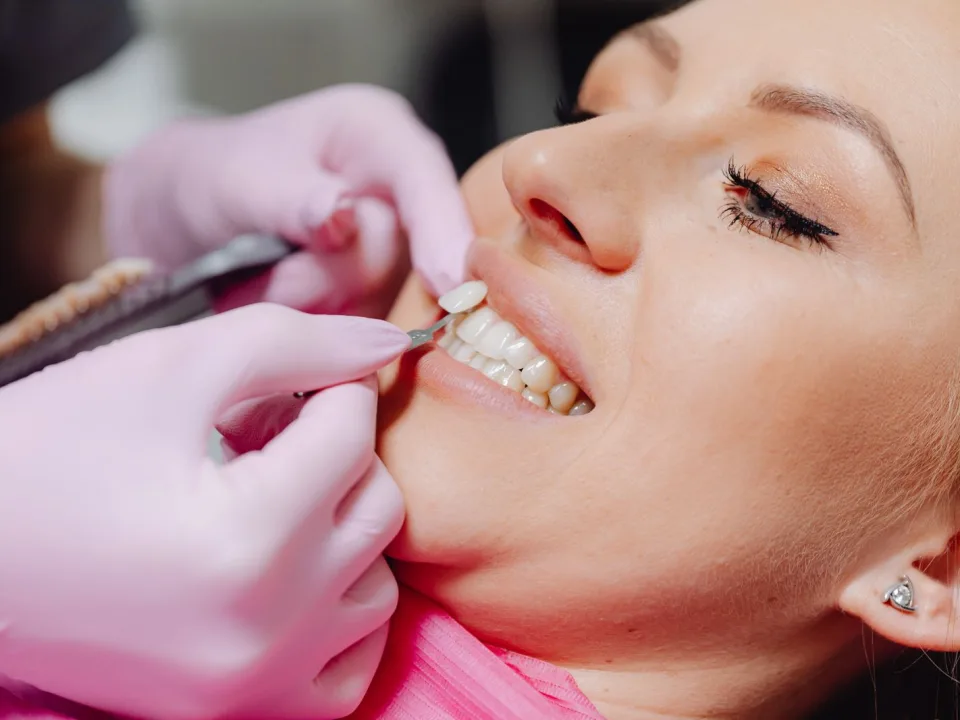
Teeth whitening in Istanbul, as we carry it out, uses a peroxide-based gel that penetrates enamel and breaks down the pigmented molecules inside it. It lightens the natural tooth; it does not lighten crowns, veneers or fillings, which is why any restoration in the smile line is factored into the plan. Whitening is often the first step of a smile makeover, so that ceramics can be matched to the new shade rather than the old one.
The examination that precedes whitening is short but not optional. Enamel thickness, gum recession, cracks and untreated decay all affect both the result and the level of sensitivity you will feel. A scale and polish immediately before treatment removes surface stain so the gel works on the tooth itself.
Who teeth whitening suits
- Yellow or brown discolouration from coffee, tea, wine and age — the most responsive type
- Patients with healthy gums and sound enamel who want a brighter shade without restorations
- Anyone planning veneers or crowns who wants a brighter baseline first
- Mild fluorosis or surface staining, with realistic expectations
When whitening is not suitable
Active decay and gum disease are treated first through general dentistry and gum treatment. Grey or banded tetracycline staining responds poorly and is usually better addressed with veneers. Whitening is not carried out during pregnancy or breastfeeding, and patients under eighteen are assessed individually. A tooth that has darkened after root canal treatment needs internal bleaching, a different procedure.
Step by step: what an in-office session looks like
- Examination and shade record: the starting shade is photographed against a reference so the change is measurable.
- Cleaning: surface stain and plaque are removed so the gel contacts enamel evenly.
- Isolation: the gums are protected with a barrier and the lips retracted.
- Gel application: a higher-concentration gel is applied in two to three cycles of about fifteen minutes, with or without light activation depending on the system.
- Neutralising and fluoride: the teeth are rinsed and a desensitising agent is applied.
- Take-home trays where planned: custom trays are fitted for a follow-up course at home.
In-office versus take-home whitening
The two methods use the same chemistry at different concentrations and timescales. Neither is intrinsically better; they suit different patients and are often combined.
- In-office: fastest change, one to two sessions, supervised, more chance of short-term sensitivity. Ideal for visitors with limited time.
- Take-home: custom trays and a lower-concentration gel worn daily for one to two weeks; slower, more controllable, less sensitivity, and the trays remain for future top-ups.
- Combined: an in-office session to start, followed by trays at home to stabilise and extend the result. This is the usual recommendation for patients travelling from abroad.
How long whitening lasts
Results typically hold for one to three years before a top-up is wanted. Coffee, tea, red wine and smoking shorten that; rinsing with water after them and brushing twice daily lengthens it. In the first forty-eight hours the enamel is more porous, so strongly coloured food and drink are avoided. A short course with the take-home trays every year or so keeps the shade without another in-office session. See aftercare for the first days after treatment.
Alternatives to whitening
Surface stain often responds to a professional clean alone, and we check that before recommending gel. Where discolouration is intrinsic, uneven or accompanied by shape problems, veneers or E-max crowns give a predictable shade that whitening cannot. Over-the-counter strips and whitening toothpastes give modest changes and cannot address the causes of sensitivity, which is why supervised treatment is safer for anyone with recession or worn enamel.
Fitting whitening into a visit to Istanbul
Whitening alone needs only one or two days: examination and cleaning on the first, the in-office session the same day or the next, and custom trays handed over before you leave. As part of a larger cosmetic plan it is scheduled first, with a two-week interval before ceramics are shade-matched, which is arranged across the visit. Details are on the international patients page.
Risks and what to watch for
Transient sensitivity to cold in the first day or two is the most common effect and is managed with a desensitising paste. Gum irritation from gel contact is minor and short-lived when isolation is done properly. Uneven results occur on teeth with white spots or bands, which is discussed beforehand. Repeated unsupervised whitening can wear enamel and cause lasting sensitivity, so top-ups are planned rather than improvised.
Related reading
How it works at Habibler Clinic
- AssessmentSend an X-ray or photos; we reply with a written outline.
- Examination & 3D scanClinical check and imaging confirm the plan and timeline.
- TreatmentSessions are scheduled together, in the order agreed.
- Follow-upWritten aftercare and scheduled check-ups.