
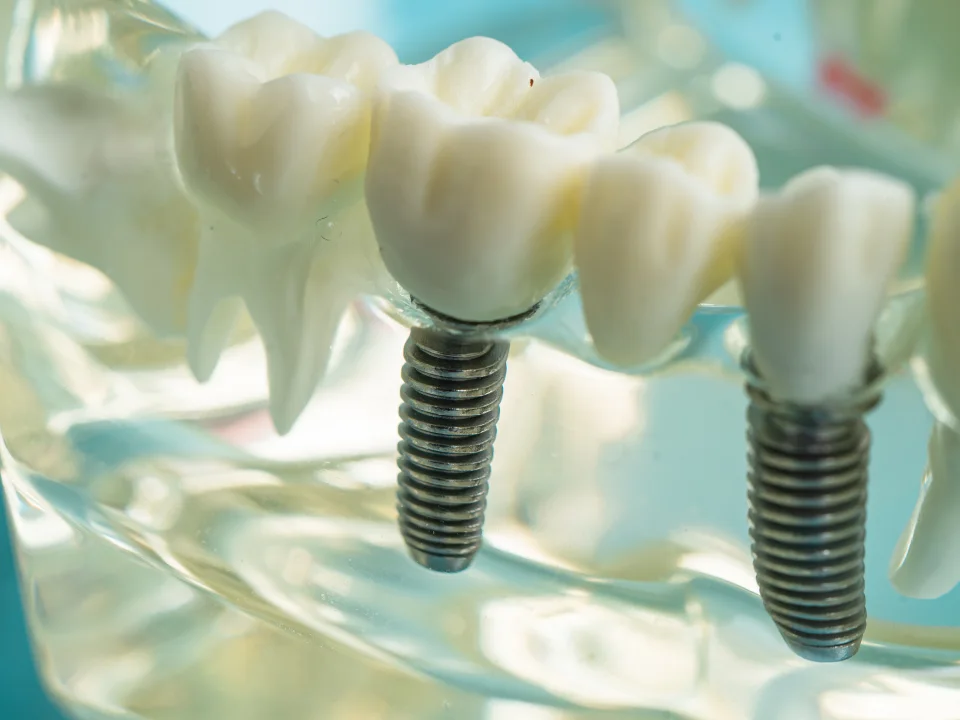
- 2 implantscan carry a 3-unit bridge
- 1 sessionsurgery for most segments
- 3–6 monthsbefore the final bridge
- 2 tripsfor international patients
What does multiple implant treatment involve?
Multiple dental implants in Istanbul are planned as a system rather than as a series of single teeth. Two or more implants are positioned so that they share the load of a fixed bridge, and the bridge spans the gap between them. A three-tooth gap can often be restored with two implants; a longer span may need three or four, depending on where it sits and how hard you bite there.
This makes it a natural step up from a single tooth implant and an alternative to a removable partial denture. For patients missing most or all of the teeth in a jaw, full-arch options such as All-on-4 and All-on-6 extend the same principle to the whole arch.
Who is it suitable for?
Patients with two or more adjacent missing teeth, patients with several gaps across the mouth, and those who have worn a partial denture for years and want something fixed are the typical groups. The requirements are the same as for any implant: adequate bone, healthy gums and a general health picture that supports healing.
- Several adjacent teeth lost to decay, gum disease or trauma
- A failing conventional bridge whose supporting teeth can no longer be saved
- Gaps on both sides of the jaw that make chewing one-sided
- A partial denture that has become loose, uncomfortable or embarrassing
When gum disease is the cause
If teeth were lost to periodontitis, the disease must be brought under control before implants are placed, otherwise the same bacteria threaten the new fixtures. A course of gum treatment is scheduled first, and the implant plan follows once the tissues are stable.
How many implants do you actually need?
There is no fixed ratio. The number depends on the length of the span, the bone available at each potential site, the forces in that part of the mouth and how the opposing teeth meet. Back teeth take much heavier loads than front teeth, so a molar span usually earns more support than a span of incisors.
The CBCT scan and a digital model of your bite are used to simulate the bridge before surgery. This often reveals that a site the patient assumed was unusable is perfectly adequate, or that one extra implant will make a long bridge far more durable. Your dentist confirms the final count after examination and imaging.
Procedure and timeline
Surgery for a segment is usually completed in a single session under local anaesthetic, with sedation available for longer or more anxious cases. Where bone is lacking, grafting or a sinus lift may be done at the same time or as a preliminary stage.
- Assessment, digital scan and CBCT imaging
- Digital planning of implant positions and the bridge design
- Implant placement, with a temporary bridge or denture where appropriate
- Integration at home for three to six months
- Impressions, framework try-in and fitting of the permanent bridge
Advantages and things to weigh up
Compared with a removable denture, an implant bridge is fixed, does not rest on the gum, and does not need to be taken out at night. Compared with a tooth-supported bridge, it does not sacrifice healthy teeth. Because the implants stimulate the bone, the ridge under the bridge holds its shape far better than it would under a denture.
On the other side of the ledger, treatment takes longer than a conventional bridge and involves surgery. A long span carried by too few implants is a false economy, which is why the planning stage is not rushed. Cleaning underneath a bridge requires a little technique, which you are shown before you leave.
Healing and long-term maintenance
Recovery mirrors single implant surgery, with slightly more swelling if several sites were opened. A soft diet for the first days, prescribed medication and gentle cleaning are all that is needed. Sutures are removed or dissolve within one to two weeks, and by then most patients have forgotten the surgery.
Long term, the bridge is cleaned with floss threaders, interdental brushes or a water flosser, and checked once or twice a year. The written aftercare instructions cover each stage and remain valid after you have returned home.
Planning as an international patient
Two trips are the norm. The first includes examination, imaging, surgery and a post-operative check, and usually needs four to five days in Istanbul. The second, for the permanent bridge, needs five to seven days because a framework try-in is added between impressions and the final fitting to make sure the fit is passive and the bite is right.
Between visits, integration is monitored through photographs and messages, and a local dentist can carry out a check if you wish. Transfers, accommodation guidance and the sequence of appointments are set out in the treatment journey, and the visits page explains what happens on each day.
Risks and warning signs
The risks are those of any implant surgery: infection, delayed healing, and in rare cases an implant that fails to integrate and must be replaced. Nerve proximity in the lower jaw and sinus proximity in the upper jaw are mapped on the CBCT precisely so that they can be respected.
Contact the clinic if swelling grows after day three, if pain is not controlled by the prescribed medication, if a temporary bridge loosens, or if you notice numbness that persists. After the final bridge is fitted, a bridge that feels high or rocks under pressure should be seen promptly rather than tolerated.
Related reading
How it works at Habibler Clinic
- AssessmentSend an X-ray or photos; we reply with a written outline.
- Examination & 3D scanClinical check and imaging confirm the plan and timeline.
- TreatmentSessions are scheduled together, in the order agreed.
- Follow-upWritten aftercare and scheduled check-ups.


