
- 5–7 daystypical stay in Istanbul
- 1 mock-upapproved before any permanent work
- 2–3 visitswithin a single trip
- 10–15 yrsexpected service of ceramic work with care
What a smile makeover actually involves
A smile makeover in Istanbul, as we plan it, is a coordinated treatment of everything that shapes how your smile is read: tooth shape, tooth length, shade, the gum line and the way the upper lip frames all of it. It may combine porcelain veneers, E-max crowns or zirconia crowns with whitening and gum contouring, or it may need only two of those. The point is that the parts are designed together rather than added one after another.
What distinguishes a makeover from a set of veneers is the planning layer. Facial photographs, a digital intra-oral scan and, where the bite is involved, a bite record are brought into a design that respects your facial midline, the curve of your lower lip and the proportions of your existing teeth. Nothing is drawn on a blank page; the design starts from your face.
Who a smile makeover suits
You are likely to be a candidate if several things bother you at once — colour and shape, or worn edges and an uneven gum line — and you want them resolved as a whole. People who have a single chipped tooth or slightly dull enamel usually need something simpler, and we will say so.
- Worn, short or uneven front teeth after years of grinding
- Discolouration that whitening alone cannot correct, such as tetracycline banding or old composite
- Gaps, mild rotations and crowding where orthodontics is not wanted or not needed
- A gummy smile or an asymmetric gum line that makes teeth look short
- Old crowns or veneers that no longer match in shade or shape
When we recommend something else first
Active gum disease, untreated decay or a clearly unstable bite are addressed before cosmetic work, because ceramics placed on an unhealthy foundation fail early. Significant crowding is often better served by orthodontics, which moves the teeth rather than covering them. The final plan is set after examination, never from photographs alone.
Step by step: from digital smile design to final ceramics
The sequence below is what most international patients experience across one visit. Complex cases involving implants or gum surgery are staged over two trips.
- Records: clinical examination, photographs, intra-oral scan, X-rays and a short conversation about what you dislike and what you want to keep.
- Digital smile design: the new tooth forms are modelled against your facial proportions and lip line, and reviewed with you on screen.
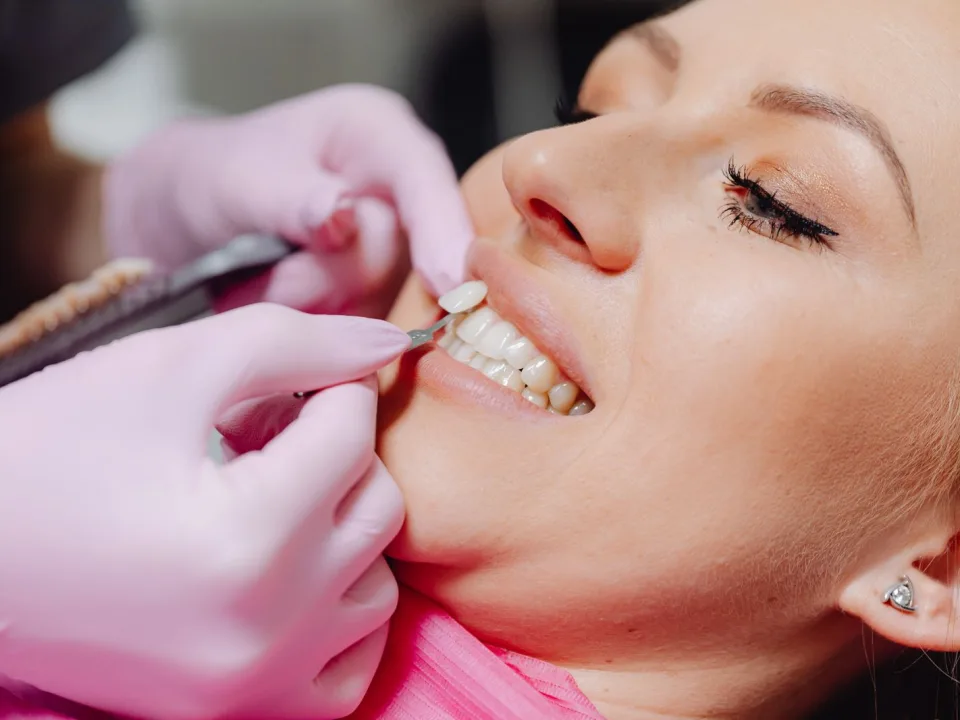
- Mock-up: the design is transferred to your teeth as a temporary resin overlay. You speak, smile and look in the mirror. Adjustments are made here, in minutes.
- Preparation: only once you approve. Teeth are minimally shaped, impressions or scans are taken, and provisional restorations are fitted in the approved design.
- Laboratory: ceramics are made to the approved model, so the final work reproduces what you already saw.
- Try-in and bonding: each piece is checked for fit, shade and bite before final cementation, with a final bite adjustment.
Veneers, E-max or zirconia: how materials are chosen
Material is selected tooth by tooth rather than for the whole mouth. The deciding factors are how much natural tooth remains, how much colour has to be masked, and how much force the tooth carries.
- Porcelain veneers: the least reduction and the most natural light behaviour; best where the underlying tooth is sound and only the front surface needs to change.
- E-max crowns: glass ceramic with high translucency; preferred for front teeth that need full coverage or a single tooth that must match its neighbours precisely.
- Zirconia crowns: strongest and most opaque; chosen for back teeth, heavy bites, or where a dark core must be hidden.
Mixing materials in one smile
It is common for a makeover to use veneers on the front six teeth, E-max where a canine needs full coverage and zirconia on premolars that carry chewing load. Because shades are matched across the set in the same laboratory, the mix is invisible in the result.
How long a smile makeover lasts
Well-indicated ceramic work commonly serves for ten to fifteen years and often longer. What shortens that is not the material but the environment: clenching, biting hard objects, and gum inflammation that changes the margin. A night guard is advised for anyone with signs of grinding, and a review with hygiene every six to twelve months keeps the margins clean. Our aftercare guidance covers the first weeks in detail.
Alternatives to a full makeover
Not every smile needs ceramics. Whitening followed by minor edge reshaping resolves more cases than people expect. Composite bonding can close small gaps and repair chips at lower cost, though it stains and wears faster than porcelain. Clear-aligner orthodontics can correct alignment so that fewer teeth, or none, need covering. We will show you the smaller option first if it can reach the result you want.
A typical visit plan for international patients
Most makeovers in Istanbul are completed in five to seven days. Day one is examination and records; day two the design review and mock-up; day three preparation and provisionals; the laboratory then needs two to three working days; the final day is try-in, bonding and bite check. Details of transfers, accommodation and scheduling are on our international patients page, and the full path from first enquiry to review is set out in the treatment journey.
Risks and what to watch for
Temporary sensitivity to cold after preparation is normal and settles within days to weeks. Provisionals can chip; they are designed to be replaced, not endured. After final bonding, a high spot in the bite should be adjusted promptly rather than waited out, because it can cause soreness or a fracture. Over-reduction, poor margins and ignoring the bite are the main causes of failure, which is why the design and try-in stages are not skipped to save a day.
Related reading
How it works at Habibler Clinic
- AssessmentSend an X-ray or photos; we reply with a written outline.
- Examination & 3D scanClinical check and imaging confirm the plan and timeline.
- TreatmentSessions are scheduled together, in the order agreed.
- Follow-upWritten aftercare and scheduled check-ups.